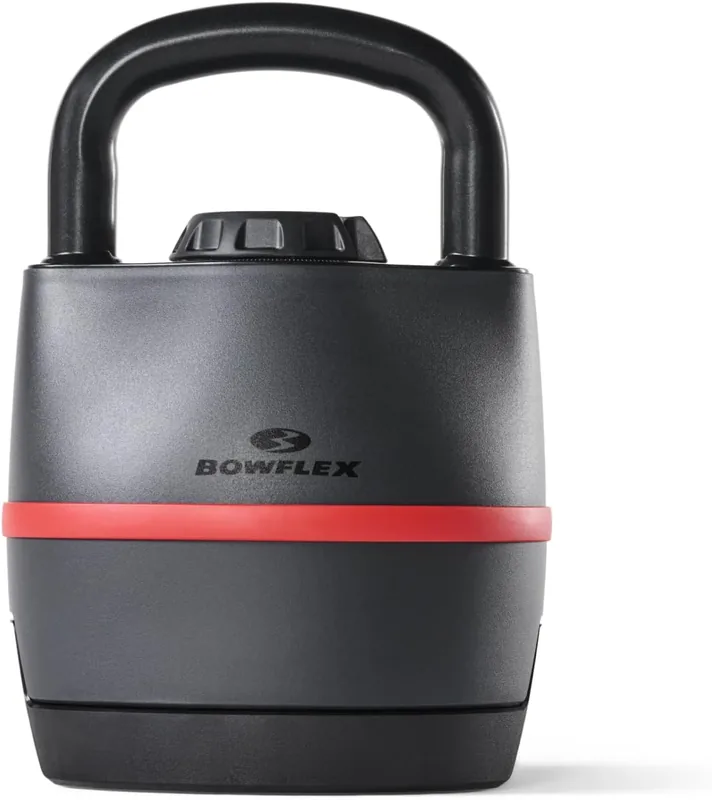
An adjustable kettlebell gets marketed the way adjustable dumbbells do — as a straightforward space-and-money upgrade over buying a full rack of fixed weights. That's true for part of the decision, but not all of it. Swapping a mechanical dial or pin system for a solid cast-iron bell is a real trade-off, not a strict upgrade, and which side wins depends more on how you actually train than on which one sounds more modern.
What an adjustable kettlebell actually solves
The core pitch is real: one unit that covers a range of weights takes the floor space of one kettlebell instead of five or six, and it means not re-buying equipment every time you progress past your current weight. For a home gym with limited space, or someone still in the phase of steadily adding weight month to month, that's a genuine, substantial benefit — not a marketing exaggeration.
The trade-off marketing doesn't lead with
A fixed-weight kettlebell is a single piece of cast iron — there's nothing to fail. An adjustable one has a dial, pin, or selector mechanism holding the weight plates in place, and that mechanism is a genuine point of failure that a solid casting simply doesn't have. It needs to be checked before every heavy lift, not just trusted by default, and it's also slower to change mid-session than grabbing a different fixed bell — a real friction point if your training style involves supersets or circuits that swap weight frequently rather than sticking with one weight for a full set.
When fixed-weight is still the better buy
- You have the space for a small rack and know roughly which 2-3 weights you'll actually use long-term.
- Your training style involves frequent mid-session weight changes (circuits, supersets) where swap speed matters more than storage space.
- Budget is tight for a single purchase — one fixed kettlebell at your target weight is cheaper upfront than an adjustable unit covering a range.
When adjustable is the better buy
- Space is genuinely limited — an apartment, a shared room, anywhere a rack of separate weights isn't realistic.
- You're still progressing and don't yet know your long-term working weight, so buying fixed weights now means re-buying later.
- You'd rather make one purchase and adjust as you go than manage a growing collection of individual bells.
The Bowflex SelectTech 840 is one concrete example of the adjustable side of this trade-off — a dial-adjustable kettlebell replacing what would otherwise be a small rack of fixed weights, at $149 with a 4.8/5 average across 7,681 Amazon ratings. Its own listed trade-offs match the general pattern above exactly: faster to store and progress with, but slower to swap weight mid-session than a fixed bell, and worth a quick lock-check before each heavy lift specifically because the adjustable mechanism is the one part a solid casting doesn't have to worry about.
The takeaway
Neither format is objectively better — an adjustable kettlebell trades mechanical simplicity and swap speed for space savings and fewer future purchases. Match the choice to how you actually train and how much room you actually have, not to which one sounds like the newer, smarter option.