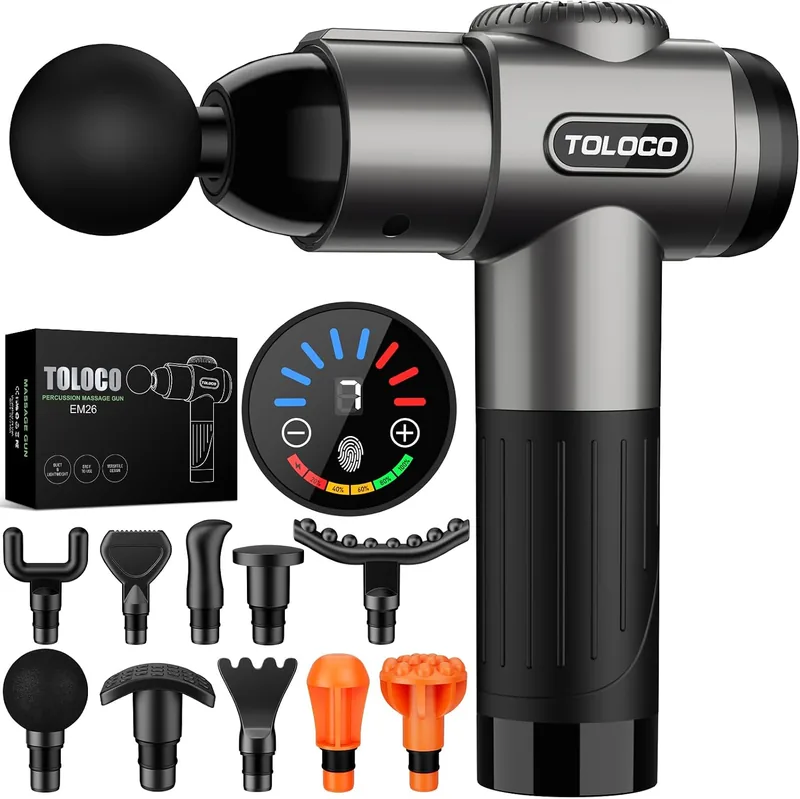
Percussion massage guns are marketed with some of the most confident-sounding claims in the whole wellness-gadget category — "relieves pain," "speeds recovery," "breaks up lactic acid." Some of that language, including some used in real Amazon product titles, leans more medical than the evidence for consumer percussion massagers actually supports. That doesn't mean the devices do nothing; it means the honest answer is narrower than the marketing.
What percussion massage is reasonably good evidence for
The clearest, most consistently replicated effect of percussive/vibration therapy is short-term: temporarily reduced muscle soreness and a temporary increase in local blood flow and range of motion, similar in category to what foam rolling or a manual massage produces. If you've finished a workout and your muscles feel tight, a few minutes of percussion on the affected area plausibly helps you feel less stiff in the following hour or so — that's a real, modest, well-supported effect, not a fabricated one.
What the "lactic acid" claim gets wrong
A specific, commonly repeated marketing claim — that percussion massage "breaks up" or "flushes out" lactic acid buildup — misrepresents basic exercise physiology. Lactate produced during exercise is cleared from the muscle within roughly an hour by normal metabolic processes regardless of what you do to the muscle afterward; it isn't a substance that accumulates and needs to be mechanically dislodged days later. This is exactly the kind of claim our Health & Wellness buying guide tells shoppers to watch for — specific-sounding language that doesn't actually hold up to the mechanism being described, versus a narrow, falsifiable claim that does.
What it's not good evidence for
Longer-term claims — "speeds muscle recovery," "improves performance," "relieves chronic pain" — are much less settled. Some small studies show modest short-term benefits on perceived soreness; there isn't strong evidence that a few minutes of at-home percussion meaningfully changes recovery timelines the way sleep, hydration, and training load do. And for anything describing itself as pain relief in a medical sense — a real injury, a diagnosed condition, chronic pain — a massage gun is not a substitute for a doctor or physical therapist's evaluation, regardless of what a product listing implies.
A practical way to use one
- Treat it as a comfort and warm-up/cool-down tool, not a treatment — a few minutes before or after a workout on a healthy, non-injured muscle.
- Start on the lowest speed and a soft head, especially on smaller or bonier areas; there's no evidence that higher intensity produces a proportionally better result, and it's less comfortable.
- Skip it entirely on any area with a suspected injury, acute pain, or inflammation, and skip it if you have a condition your doctor has told you to avoid vibration or deep pressure for.
- If soreness or pain is persistent rather than the normal post-workout kind, that's a question for a medical professional, not a gadget.
If you're curious about the category but not ready to spend $200+ on a name-brand unit, our TOLOCO massage gun review covers a budget option with the same core mechanism (a brushless motor, multiple interchangeable heads, adjustable speed) at a fraction of the price — a reasonable way to find out if you'll actually use one regularly before spending more.
The takeaway
Percussion massage guns have real, modest, short-term evidence behind them for muscle soreness and stiffness — not the broader "recovery" and "pain relief" claims some marketing implies. Used as a comfort tool around a workout, they're a reasonable, low-risk purchase. Used as a substitute for treating a real injury or medical condition, they're the wrong tool for the job.