
Honeywell HCM350B Review 2026: Humidifier Verdict
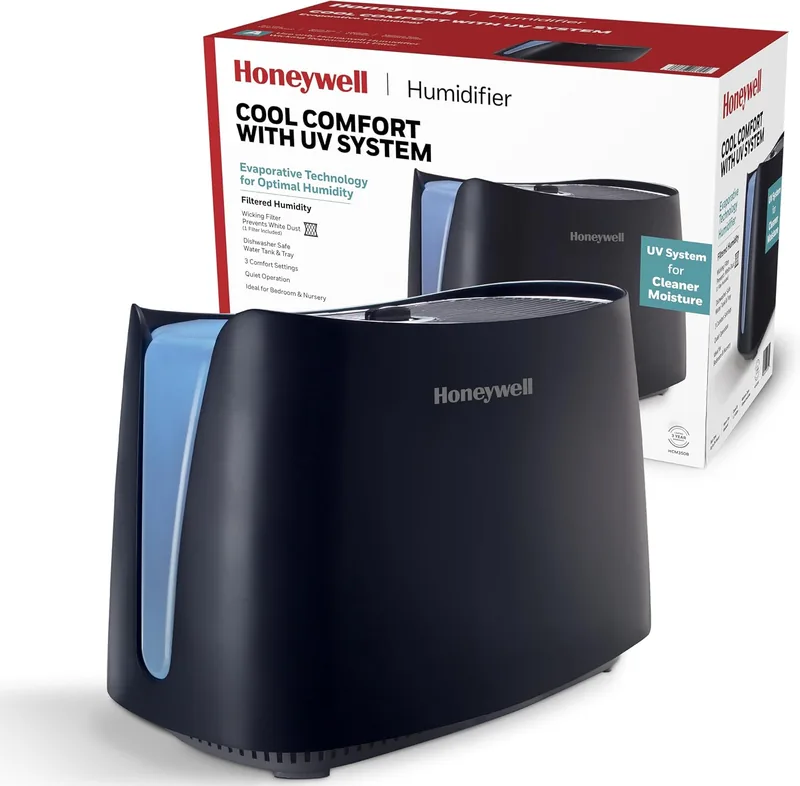
Honeywell HCM350B Cool Moisture Humidifier
Evaporative "cool moisture" humidifier with UV water treatment for bedrooms and medium rooms
↑ Affiliate link — we may earn a commission at no extra cost to you
Table of Contents
What Is the Honeywell HCM350B?
The Honeywell HCM350B is an evaporative "cool moisture" humidifier with a 1.1-gallon tank, built for bedrooms and medium-sized rooms rather than open-plan living spaces. Unlike an ultrasonic humidifier that vibrates water into a visible mist, the HCM350B pulls water up through a replaceable wicking filter and blows room-temperature air through it, releasing invisible moisture into the air. It's part of Honeywell's "Germ Free" line, which adds a UV light stage inside the tank — Honeywell's own listing describes this as treating standing water before it reaches the wick, which matters because a humidifier's water reservoir is exactly the kind of standing water that needs regular cleaning regardless of what treatment stage is built in.
How We Picked This
This isn't a hands-on test writeup. We picked the HCM350B by checking its evaporative, filter-based design against a specific complaint that comes up constantly with ultrasonic humidifiers: white mineral dust settling on furniture near the unit when tap water isn't distilled. An evaporative design is structurally immune to that particular problem, since it can't aerosolize dissolved minerals the way ultrasonic vibration does — the trade-off is a wicking filter that needs periodic replacement instead. We weighed that structural trade-off against Amazon's aggregate verified-purchase rating (4.4 out of 5 across 3,690 ratings). This is disclosed research, not the multi-week in-use testing we run when it's practical — see how we research products.
Key Features
Three things matter most when deciding if an evaporative humidifier fits your room better than an ultrasonic one.
1.1-Gallon Tank Sized for Medium Rooms
Honeywell markets this specific model for bedrooms and medium rooms rather than large open spaces — a 1.1-gallon tank is enough for roughly a full night's run without needing a refill, but it's not sized to keep up with a large living room or an open-plan floor.
Wicking Filter Instead of Ultrasonic Mist
The evaporative design is self-regulating by nature: the air can only absorb as much moisture as it can hold, so the unit can't easily over-humidify a room the way an ultrasonic model can. The trade-off is a wicking filter (Honeywell's own HAC-504 replacement filters) that needs periodic swapping as minerals build up on it — treat that as a recurring cost, not a one-time purchase.
UV Water Treatment Stage
Honeywell's listing states the tank includes a UV light that treats standing water before it's drawn into the wick, which the company describes as reducing bacteria and mold in the reservoir. That's specifically a claim about the water tank's cleanliness, not a medical claim about the air you breathe — and it doesn't replace regularly emptying, rinsing, and drying the tank between uses, which matters for any humidifier regardless of what treatment stage is built in.
What Amazon Buyers Say
As of writing, the HCM350B holds a 4.4-out-of-5 average across 3,690 Amazon ratings. We didn't generate this number ourselves; it's Amazon's own aggregate verified-purchase data, visible on the product listing linked below. A strong average at this sample size is a reasonable proxy for "most buyers didn't return this or regret it," though it doesn't replace independent lab testing of the exact humidity output or filter longevity claims.
Where to Buy the Honeywell HCM350B
Honeywell sells several humidifiers under similar "HCM" model numbers at different tank sizes and price points, so confirm the model number matches before buying.
| Retailer | Price | Shipping | Notes |
|---|---|---|---|
| Amazon | $76.42 | Varies by delivery location | Confirm "HCM350B" model, not a different tank-size variant |
Honeywell HCM350B Pros & Cons
Pros
- No mineral dust on furniture — evaporative design can't aerosolize dissolved minerals like ultrasonic models can
- Self-regulating output that's harder to over-humidify a small room with
- Strong aggregate Amazon rating across a large sample (3,690 ratings)
- UV water-treatment stage in the tank, per Honeywell's own spec
Cons
- Wicking filter is a recurring cost, unlike filter-free ultrasonic models
- Sized for bedrooms and medium rooms, not large open-plan spaces
- Still needs regular tank cleaning regardless of the UV stage
Who Should Buy the Honeywell HCM350B?
Anyone humidifying a bedroom or medium room with hard tap water who's tired of wiping mineral dust off nightstands from a previous ultrasonic unit. It also fits anyone who'd rather deal with an occasional filter swap than fine-tune an ultrasonic model's mist output to avoid over-humidifying a small space.
The Honeywell HCM350B is NOT right for you if: you're humidifying a large open-plan room — a 1.1-gallon tank sized for bedrooms won't keep pace there — or you'd rather avoid recurring filter costs entirely, in which case a filter-free ultrasonic model is the simpler trade-off.
Other Home & Lifestyle Picks
If a humidifier isn't what you're shopping for, here's what else we're currently featuring in the same category — not direct substitutes, just other researched picks:
- Levoit Core 300 — a HEPA air purifier for the same room, filtering particles rather than adding moisture
- eufy 11S MAX Robot Vacuum — unrelated category, similarly researched
Final Verdict: Is the Honeywell HCM350B Worth It?
For a bedroom or medium room where hard tap water rules out an ultrasonic model, the HCM350B trades a recurring filter cost for a self-regulating, dust-free evaporative design and a UV-treated tank — a reasonable trade for anyone who's already dealt with mineral dust from a previous humidifier.
Amazon Rating: 4.4/5 (3,690 ratings)
Research-based pick, not an in-house hands-on test — see disclosure above.
Check Price on Amazon →↑ Affiliate link — we may earn a commission at no extra cost to you