Multicooker listings lead with two numbers — watts and quarts — and the shopping instinct is to treat both like simple "bigger is better" scores. Neither one works that way once you look at how they're actually used. A higher wattage doesn't mean faster cooking across the board, and a "6-quart" pot doesn't mean you can pressure-cook 6 quarts of food in it. Here's what each number actually tells you.
Wattage measures heating power, not cooking speed
A multicooker's wattage rating describes how much electrical power its heating element can draw, which determines how quickly it can raise temperature and how much heat it can sustain once there. It does not directly translate into "cooks food faster" the way a higher horsepower engine translates into a faster car — total cook time depends on the recipe, the fill volume, the starting temperature of the ingredients, and the cooking mode (pressure vs. slow-cook vs. sauté all use the element differently).
Where wattage does matter concretely is preheat time — how long a pressure-cooking multicooker takes to build up to pressure before the actual countdown timer even starts. A lower-wattage unit isn't a worse pressure cooker once at pressure, but it will typically take longer to get there, which matters if you're timing a meal around a fixed schedule rather than just total elapsed time.
The quart number is the pot's total volume, not its usable capacity
This is the part that catches new multicooker owners off guard: the advertised capacity (say, 3, 6, or 8 quarts) is the physical volume of the inner pot to its rim — not how much food you can actually cook in pressure mode. Pressure cookers need headspace for steam to build and circulate safely, so manufacturer instructions (and UL/ETL safety certification requirements behind them) specify a maximum fill line well below the rim:
- Most foods: fill to no more than 2/3 of the pot's total volume.
- Foods that foam or expand (rice, beans, grains, stocks): fill to no more than 1/2 of the pot's total volume — foam can block the pressure release valve if the pot is overfilled.
Practically, that means a "6-quart" multicooker used for a pot of beans has a real usable capacity closer to 3 quarts, not 6. If a recipe or a household size guide is telling you to buy based on the labeled quart number alone, it's overstating how much that pot can actually hold for a lot of common dishes.
Sizing for your household, correctly
Once you account for the fill-line rule above, a rough sizing guide looks like this:
- 1-2 people: a 3-quart pot is workable for everyday meals, single proteins, or side dishes — but tight for anything foamy at full recipe size.
- 3-4 people: 6 quarts is the most common "do everything" size, and where the 2/3-vs-1/2 fill-line distinction matters most in practice.
- 5+ people or batch cooking: 8 quarts gives more headroom, though it's also heavier and takes up more counter and storage space — worth confirming you actually have the room before sizing up "just in case."
What to actually check before buying
- The stated wattage — mainly as a signal for how long preheat/come-to-pressure will take, not overall cooking quality.
- The quart size relative to the 2/3 (most foods) and 1/2 (foamy/expanding foods) fill-line rule, not the raw number on the box.
- UL or ETL safety certification specifically for the pressure function — this is the independent testing mark that confirms the pressure-release and lid-lock mechanisms meet a real safety standard, which matters more for a pressure appliance than for a slow cooker or a sauté pan.
- Counter and cabinet space for the size you're actually sizing up to, especially at 8 quarts.
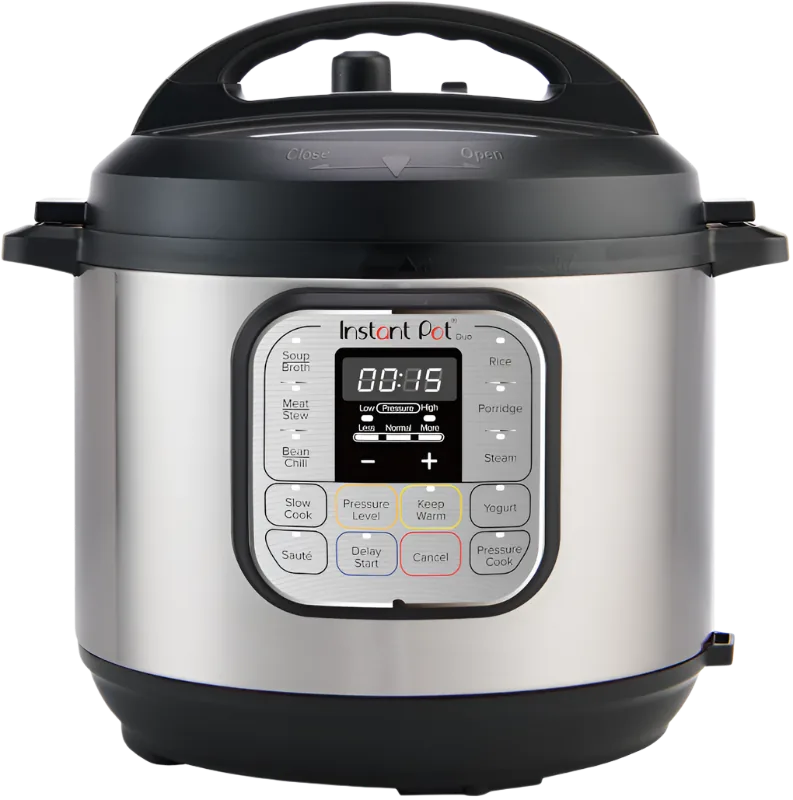
The Instant Pot Duo Mini is a compact example sized at the smaller end of this range — a 3-quart pot aimed at the 1-2 person household bracket above, which is the sizing bracket where the fill-line math matters least since single-portion cooking rarely pushes against the 2/3 or 1/2 ceiling. The same wattage-vs-preheat-time and fill-line logic in this guide applies the same way to any multicooker you're comparing it against, regardless of brand.
The same gap between a manufacturer's headline number and real-world output shows up outside multicookers, too. Our Euhomy nugget ice maker review covers a countertop unit rated at up to 35 lbs of ice per day — a best-case manufacturer figure that depends on water temperature, room temperature, and how often the basket gets emptied, not a guaranteed daily minimum, the same way a "6-quart" pot's rim-to-rim volume isn't its real pressure-cooking capacity.
The takeaway
Wattage and quart size are both real, meaningful numbers — they're just not the "bigger equals better" shortcuts the marketing implies. Wattage mostly affects how long preheat takes, not the quality of what comes out. And a pot's labeled capacity is its total volume, not its usable pressure-cooking capacity — the real number to size around is 1/2 to 2/3 of what's printed on the box, depending on what you're cooking.